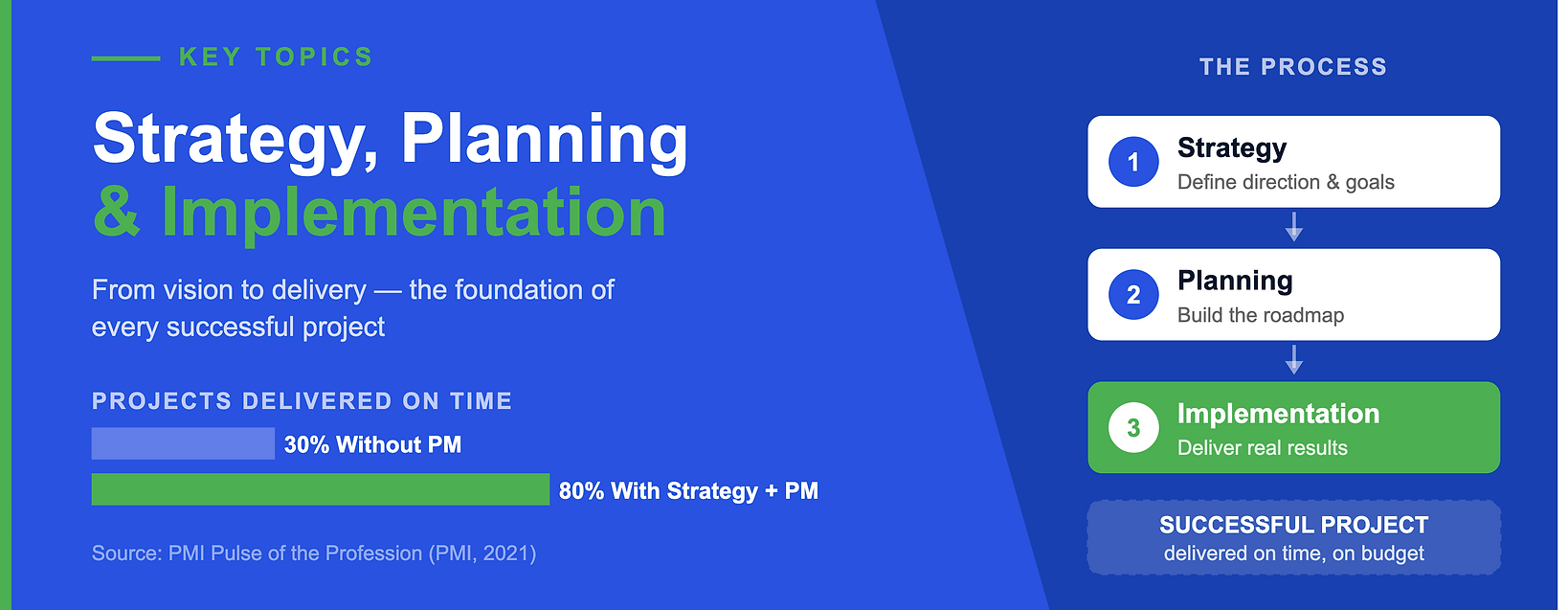
Successful project management requires a clear strategy, detailed planning and effective implementation. These stages ensure that projects are aligned with organisational goals, structured properly and executed efficiently.
Monitoring & Control
Tracks progress, manages risks, and ensures the project stays on time, within budget and aligned with objectives.


Before planning any project, set a SMART goal: Specific, Measurable, Achievable, Relevant and Time-bound. A vague goal like "improve our social media" cannot be planned or measured. A SMART goal - "increase Instagram followers from 200 to 500 by June 2026 by posting three times per week" - gives your team a clear target and a way to measure success.
Why Strategy, Planning and Implementation Matter
Applying a structured approach to strategy, planning and implementation helps organisations deliver projects more effectively. For charities and small businesses, this is particularly important as resources are often limited and projects must be delivered efficiently to maximise impact.
-
Ensures projects are aligned with organisational goals
-
Improves efficiency and resource allocation
-
Reduces risks and uncertainty
-
Enhances coordination and communication
-
Increases the likelihood of successful project delivery
(Doran, 1981; Kotter, 1996).

Set SMART Goals Before You Plan Anything
Before you start planning tasks and timelines, make sure your project goal is SMART - Specific, Measurable, Achievable, Relevant and Time-bound.
A vague goal like "improve our social media" cannot be planned or measured. A SMART goal gives your team a clear target and a way to measure success.
Example for an Irish charity:
Bad goal: "Improve our fundraising"
SMART goal: "Raise €5,000 through our online fundraising campaign by 30th June 2026 by emailing our donor list twice per month and posting on social media three times per week"
The difference is not just clarity - it is accountability. A SMART goal tells everyone involved exactly what they are working towards and makes it easy to measure success when the project ends. (PMI, 2021)
You do not need complex software to plan a project well. A simple one-page plan answering these six questions is enough to get started:
-
What are we trying to achieve? (Your SMART goal)
-
Why does it matter? (The problem it solves)
-
Who is involved? (Your team and key stakeholders)
-
What are the key tasks? (Break the project into 5 to 10 steps)
-
When does each task need to be done? (Your timeline)
-
What could go wrong? (Your top 3 risks and how you will handle them)
Download a free one-page project plan template from our Tools and Resources page.